
Not So Funny: Methotrexate and Nitrous Oxide
Sep 14, 2026
Most of the drug interaction questions I get involve serotonergic substances. Someone is on an SSRI and wants to take psilocybin or MDMA. Someone else wants to know whether trazodone and ayahuasca is dangerous. Those are the questions that typically fill my inbox.
This one was different. It did not involve 5HT2A receptors and psychotropics. It involved a vitamin, an enzyme, and two drugs with converging mechanisms that could compromise the same metabolic pathway from different directions. The inquiry on my desk was real and open ended: An aging festival goer or ‘burner’ had been started on weekly methotrexate for rheumatoid arthritis and wanted to know what was still safe for them now that they were on it.
After a literature search I hit on something I had not highlighted before that felt worthy of a cautionary blog: methotrexate (MTX) and nitrous oxide (N2O, or laughing gas). The combination has produced seizures, leukoencephalopathy, and what the product labeling calls severe, unpredictable myelosuppression.1 Here is what is happening, and what I could find that helps us make inferences about the possible risks of mixing them.
What is methotrexate and what is it used for?
Methotrexate is an antifolate, or antimetabolite. It inhibits dihydrofolate reductase, the enzyme that regenerates tetrahydrofolate.2 Tetrahydrofolate is the body’s working currency of one carbon metabolism. Cells need it to build thymidine for DNA, to build purines, and to convert homocysteine back into methionine. Blocking dihydrofolate reductase starves all of that at once, which harms rapidly dividing cells more than others.
At high doses, methotrexate is chemotherapy, given intravenously and intrathecally in acute lymphoblastic leukemia, osteosarcoma, and central nervous system lymphoma. More commonly, and at lower doses of usually 7.5 to 25 mg once weekly, it is used in rheumatoid arthritis and is a mainstay in psoriasis, psoriatic arthritis, and inflammatory bowel disease. A single dose is also used to terminate ectopic pregnancy. The low-dose weekly population is the one this article is really focusing on, because these people are not in a hospital or seriously ill, they’re the ones that send me inquiries.
The plasma half-life of methotrexate is short, estimated at 3 to 10 hours with weekly oral schedules,1 so by the day after a dose there is very little left in the blood. However, plasma methotrexate is not what drives this interaction. Inside cells, methotrexate is converted into polyglutamate forms that are trapped intracellularly and keep inhibiting dihydrofolate reductase long after the drug is cleared from plasma. In red blood cells the elimination half-lives of methotrexate polyglutamates run from about 1.2 to 4.3 weeks, and the median time for them to become undetectable after stopping the drug ranges from about 4 to 10 weeks.3,4
That gap between plasma concentration and biologic effect in tissue is where hidden interaction risk lives. People may assume that because methotrexate is dosed weekly, they are off it six days out of seven. Pharmacologically they are not.
While methotrexate can produce various side effects and toxicities, the toxicity that usually matters most within this treatment population is hematologic. A 2026 systematic review of adverse events with low-dose methotrexate in rheumatoid arthritis reported cytopenia incidence rates of 2.4% to 5.6%, with pancytopenia identified as a potentially fatal complication. Published cases have included severe pancytopenia after a cumulative dose of only 15 mg taken over three days.5 The risk factors that appeared consistently across studies were renal impairment, advanced age, hypoalbuminemia, folate deficiency, dosing errors, and concomitant medications.6 It seems a good point to acknowledge here that festivals may have hot environments, dehydration can causes acute renal impairment, and the adverse effect profile of methotrexate could be magnified under those conditions.
We will now extend that last risk factor, concomitant medications, to include nitrous oxide gas.
What is nitrous oxide, what is it used for, and how is it supplied?
Nitrous oxide is an anesthetic gas with sedative and analgesic properties. The non-ordinary state of consciousness occurs because it is a noncompetitive NMDA receptor antagonist, meaning it blocks glutamate receptors in a way that has broad mechanistic similarity to ketamine, although the block is neither strongly voltage dependent nor use dependent the way ketamine’s is. It also stimulates kappa opioid receptors at therapeutically relevant concentrations, partially inhibits Cav3.2 T-type calcium channels, weakly potentiates GABA-A receptors, and activates mTOR, BDNF and TrkB, and nitric oxide synthase signaling.7
There is an early signal for efficacy as a rapid-acting antidepressant. In treatment-resistant major depression, one hour of 50% nitrous oxide improved HAM-D scores by 4.8 points at 2 hours and 5.5 points at 24 hours compared with placebo,8 and a later phase 2 trial found 25% worked as well as 50% with substantially fewer adverse effects.9 I raise this because it changes the population at risk. If nitrous oxide were only a dental gas and a recreational inhalant, the group exposed to the interaction below would be relatively narrow. If it is being studied as a psychiatric treatment and offered or discovered outside of trials, the overlap with people taking methotrexate becomes wider than it looks today.
In medicine it has served as an inhaled anesthetic and analgesic since the 1800s, typically delivered at 30% to 70% in oxygen through a scavenged circuit.10 Dentists use it. Labor and delivery units use it. Pediatric oncology units have used it for sedation during lumbar punctures, and that is where the story of its’ drug interaction with methotrexate began.11
Commercially, nitrous oxide is a food propellant, which is the legal framing that keeps it in the consumer market. Markets have capitalized on that loophole, and suppliers now sell larger cylinders under a commercial guise aimed directly at the recreational user.12 In 2025 the FDA advised consumers not to inhale these products, naming fifteen brands including Galaxy Gas, Whip-it!, Cosmic Gas, HOTWHIP, FastGas, and Miami Magic. The agency cited vitamin B12 deficiency, paralysis, spinal cord and brain damage, blood clots, asphyxiation, psychiatric disturbance, and death.13
Before going further I want to delineate some vocabulary, because the published literature does not use it consistently and neither does the market. Three things get confused: the container, the vessel it is decanted into, and the dose. For the rest of this article I count exposure in grams of nitrous oxide and in liters of gas, because those are the only units that let us compare a recreational session with a clinical one.
|
Term |
What it refers to |
Nitrous oxide content |
|
Charger |
The small steel cartridge sold for whipped cream siphons. Published case series call these bulbs, canisters, cans, or whippets, usually without defining them. They are the same object. |
8 g, which is about 4.4 liters of gas at room temperature |
|
Cylinder |
The larger vessels now marketed to recreational users, which make the gas cheaper and support heavier use.12 |
Many chargers’ worth in a single vessel |
|
Balloon |
Not a container. Gas is discharged from a charger or cylinder into a balloon and inhaled from it, at close to 100% concentration. |
Roughly one charger per balloon |
Reported quantities used vary enormously. An Australian toxicology series of 22 patients reported a median of 300 chargers per day, about 2,400 g, for a median of six months.14 A United Kingdom series described 20 to 500 chargers per session, about 160 to 4,000 g.15 A published case describes a woman who escalated from four chargers per week to as many as 50 per day, about 400 g daily.16 These are toxicology case series, so they describe people with an established problem rather than typical use.
What is the drug interaction potential and mechanism of toxicity between methotrexate and nitrous oxide?
This is a pharmacodynamic interaction. Neither drug changes the absorption, metabolism, or clearance of the other. They converge to inhibit the same metabolic pathway.
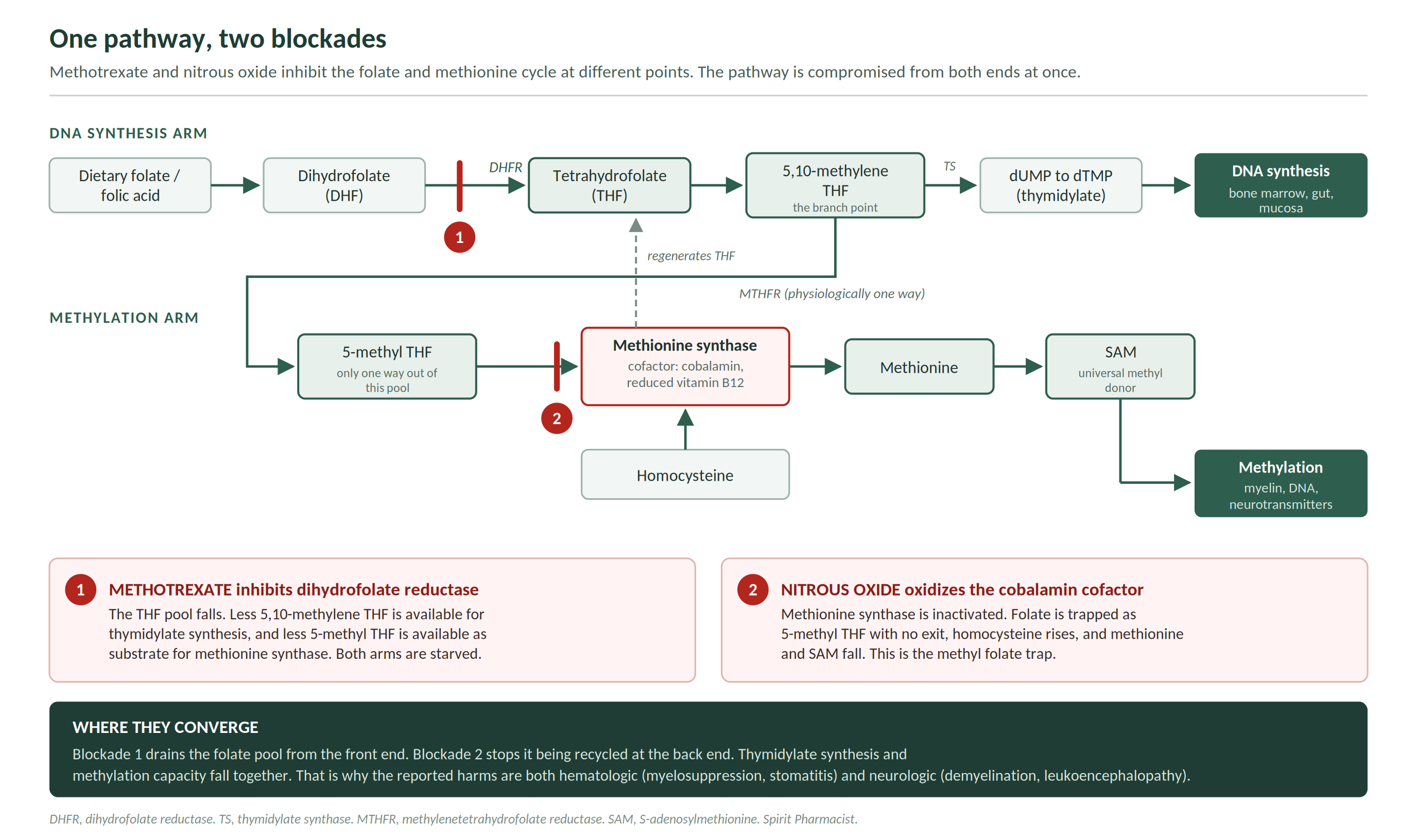
Nitrous oxide oxidizes the cobalt atom of cobalamin from its active reduced state into an inactive oxidized state.16 Cobalamin in that form can no longer serve as a cofactor for methionine synthase, the enzyme that moves a methyl group from 5-methyltetrahydrofolate onto homocysteine, producing methionine and regenerating usable tetrahydrofolate.11,17 Therefore, Nitrous oxide functionally blocks methionine synthase.
Two things happen when methionine synthase goes down. First, homocysteine accumulates because it cannot be remethylated, methionine falls, and with it S-adenosylmethionine, the methyl donor required for myelin production. Second, the cell becomes functionally folate deficient even with normal folate stores, because methionine synthase is the only reaction that pulls it back into the usable pool (THF).
Now add methotrexate. Methotrexate blocks dihydrofolate reductase, which drains the tetrahydrofolate pool from the front end. The pathway is inhibited at both ends at once, and the antifolate effect on DNA synthesis is amplified. Pediatric leukemia patients on methotrexate show lower cerebrospinal fluid S-adenosylmethionine than age-matched controls, alongside higher myelin basic protein, a marker of myelin breakdown.2,18
Figure 1. The folate and methionine cycle with both blockade points. Methotrexate inhibits dihydrofolate reductase. Nitrous oxide oxidizes the cobalamin cofactor of methionine synthase. Thymidylate synthesis and methylation capacity fall together, which is why the reported harms are both hematologic and neurologic.
The methotrexate prescribing information states it plainly in the drug interactions section, under the heading of combinations to avoid. The use of nitrous oxide potentiates the effect of methotrexate on folate metabolism, yielding increased toxicity such as severe, unpredictable myelosuppression and stomatitis.1 The British National Formulary advises avoiding nitrous oxide in patients taking methotrexate.2
Severe and unpredictable are the operative words. This does not mean risks are unrelated to dose. It means nobody has built a dose-proportional model accurate enough to use for making the combination safe.
Is huffing whippets higher or lower risk for drug interactions than nitrous oxide at the dentist?
It depends on cumulative exposure, so let us put both on the same scale.
For dental sedation, a flow rate of 5 to 7 L/min is generally acceptable for older children and adults, and 30% to 40% nitrous oxide usually achieves the intended effect, with 50% treated as a ceiling for routine use.19 That works out to roughly 1.5 to 2.8 L of nitrous oxide per minute. A 30 to 60 minute appointment therefore delivers somewhere between about 45 and 170 liters of nitrous oxide. One charger holds 8 g, which is about 4.4 liters of gas. So a dental appointment delivers the gas equivalent of roughly 10 to 38 chargers, given continuously at a third of the concentration.
For comparison, two or three balloons at a festival is about 9 to 13 liters of gas, well under a single dental visit, although the gas is delivered at close to 100% rather than 30%. A full box of 24 chargers over an evening comes to about 107 liters, which lands inside the range of one dental appointment rather than far beyond it. The heavy-use figures reported are astounding. At 300 chargers in a day, a person is inhaling roughly 1,300 liters, on the order of eight to thirty dental appointments’ worth of gas in a single day, repeated for months.14
Volume is a rough proxy. The metric that actually predicts enzyme inactivation is concentration multiplied by time. Methionine synthase inactivation in human liver increases progressively as that product increases, and patients anesthetized with 50% to 70% nitrous oxide had roughly 47% lower activity than patients anesthetized without it.20 The two patterns differ in shape. Dental delivery holds a moderate concentration steady for the whole appointment, while balloon use spikes to near 100% for seconds at a time with room air in between. What the volume comparison does establish is that casual recreational use is not automatically a larger exposure than a routine dental visit, but heavy use plainly is.
One question a methotrexate user may have is whether spacing balloons out helps. I’d say not. Nitrous oxide leaves the body within minutes of the last breath,17 but the enzyme inactivation does not. After only 75 to 230 minutes of anesthetic nitrous oxide, methionine synthase activity in white blood cells reached its nadir 5 to 48 hours later, had not fully recovered at 7 days, and plasma homocysteine was still elevated by roughly 29% on day 7.21 Repeated use, even with breaks between sessions, accumulates rather than resets.
Setting matters too. A dental exposure happens once, under supervision, with oxygen and scavenging, and usually after somebody asks for a medication history. Recreational use can repeat, with no cobalamin screening, and often in poorly ventilated spaces where asphyxiation is a separate and immediate hazard.13 And in a person on methotrexate, every one of those exposures lands on a pathway that is already inhibited at the other end.
What are the known cases and consequences of mixing methotrexate and nitrous oxide?
Much of what I am telling you is inference, and this is the section where speculation could outrun evidence. There is no published case I could identify of a person on low-dose weekly methotrexate for an autoimmune condition developing toxicity from recreational nitrous oxide.
What exists is case-level evidence from pediatric oncology, where nitrous oxide sedation and intrathecal methotrexate were given in the same procedure. Severe neurotoxicity has been reported in that setting, including seizures and leukoencephalopathy on imaging, in one case taking twelve months to resolve completely.22,2 Methotrexate neurotoxicity there is not directly dose related and does not necessarily occur on first exposure or on re-exposure after a neurological event,2 which is what a threshold effect governed by acquired cofactor status looks like rather than a genetic one. Genome-wide association studies have not identified predictive markers.2 On the strength of this evidence, a 2020 review in Paediatric Anaesthesia called for avoiding nitrous oxide in children receiving concurrent methotrexate.11
The reported cases were multifactorial, and the contributing factors are worth naming because they are common. Low vitamin B12 status leaves little functional cofactor in reserve. Proton pump inhibitors such as omeprazole delay methotrexate elimination and reduce dietary vitamin B12 bioavailability.2 Trimethoprim-sulfamethoxazole is itself an antifolate and appears in the same toxicity reports.23 Nonsteroidal anti-inflammatory drugs delay methotrexate elimination, and serious adverse reactions including deaths have been reported with that combination.1 Any one of these narrows the margin before nitrous oxide is added.
Nitrous oxide is also known to do damage on its own, with no methotrexate in the picture. Heavy recreational use produces subacute combined degeneration of the spinal cord and sensorimotor polyneuropathy with elevated methylmalonic acid and homocysteine, sometimes with lasting disability despite prolonged rehabilitation.14,15 The presentation has been mistaken for Guillain-Barre syndrome,24 and it has ended in death.25 A 2026 review identified more than 40 thrombotic events across 18 studies in young users without conventional cardiovascular risk factors, with hyperhomocysteinemia nearly universal and often despite normal serum vitamin B12.26
So the foundation here is a gas that is capable of causing myelopathy and clots on its own, combined with a drug whose labeling tells you not to use the two together. I do not need a spate of case reports with that exact pairing to take this one seriously.
How long would you need to avoid methotrexate to use nitrous oxide safely?
The labeling and the formulary both say avoid. If nitrous oxide is one option among several for a medical or dental procedure, say that you take methotrexate, and let the anesthetist or dentist choose something else.11 Practically, continuing methotrexate and skipping the nitrous oxide is the advisable path. Methotrexate is a disease-modifying therapy for a condition that damages joints, skin, or bowel when it is undertreated. Recreational nitrous oxide is optional, and the gas is not approved to treat any psychiatric condition. Stopping a disease-modifying drug for two or three months to accommodate an optional exposure trades a documented disease risk for an upside that may not exist.
There are two real clinical situations where timing genuinely matters. The first is when methotrexate is being stopped anyway, for remission, for pregnancy planning, or for another clinical reason, and the person wants to know when the antifolate effect is actually gone. Based on red cell polyglutamate elimination, that is roughly 4 to 10 weeks, with wide variability between individuals.3 I would want the longer end of that range before I stopped thinking about it.
The second runs in the other direction. Say a dental procedure used nitrous oxide and a doctor now wants to start methotrexate for psoriasis. Based on methionine synthase recovery and homocysteine normalization after anesthetic exposure,21 I would want at least one week and preferrably about two weeks. For anyone with a heavy or chronic pattern of nitrous oxide use, I would want homocysteine and methylmalonic acid back in range rather than a fixed interval, because functional cobalamin status is what determines the risk.
Summary and high points
Methotrexate blocks the regeneration of tetrahydrofolate. Nitrous oxide destroys the cobalamin cofactor needed by methionine synthase, the enzyme that recycles it. Together they have additive effects that collapse methylation and thymidylate pathways, and the published consequences are seizures, leukoencephalopathy, and severe, unpredictable myelosuppression.
The evidence base resides in pediatric oncology, not recreational use, which is a limitation of what is presented here. Nobody has published a case of recreational nitrous oxide combined with low-dose weekly methotrexate. However, the mechanism is the same one, the manufacturer’s labeling warns about it,1 and the British National Formulary advises avoidance.2 Waiting for a case report before taking a documented mechanistic interaction seriously is not a standard I would apply to my own care. If I was running a clinical trial exploring ‘laughing gas assisted therapy’ I’d exclude methotrexate users from my study population.
- Weekly dosing of methotrexate creates polyglutamates whose effects on tetrahydrofolate pools persist for weeks. There is no clever day of the week that makes combining it with nitrous oxide safe
- Nitrous oxide effects on folate metabolism greatly outlast its effects on consciousness. The gas is gone in minutes and the enzyme is still impaired a week later
- A normal serum vitamin B12 does not mean normal function. Homocysteine and methylmalonic acid are the tests that answer that question
- Casual recreational use is a smaller gas exposure than most people assume, and smaller than a dental visit. Heavy use is far larger than either
- There is no known safe way to use nitrous oxide while taking methotrexate
How This Article Was Made
The article was inspired from a client consultation question. I ran the initial literature search, found the nitrous oxide interaction in the methotrexate product labeling, and decided it was worth exploring more and writing up. I then worked with Claude (Anthropic) in September 2026 to search the literature systematically, draft and redraft the text, and build the pathway figure. I directed the structure and clinical position, revised the piece until satisfied, and verified sources. Please let me know what you think or if any inaccuracies have occurred at admin@spiritpharmacist.com
This article is educational and is not a substitute for individualized medical advice. Nothing here constitutes medical clearance for any drug use or for any change to a prescribed medication. Talk to your prescriber before changing how you take methotrexate.
References
- Methotrexate 2.5 mg Tablets. Summary of Product Characteristics. Electronic Medicines Compendium. Accessed September 8, 2026. https://www.medicines.org.uk/emc/product/511/smpc
- Forster VJ, van Delft FW, Baird SF, Mair S, Skinner R, Halsey C. Drug interactions may be important risk factors for methotrexate neurotoxicity, particularly in pediatric leukemia patients. Cancer Chemother Pharmacol. 2016;78(5):1093-1096. doi:10.1007/s00280-016-3153-0
- Dalrymple JM, Stamp LK, O'Donnell JL, Chapman PT, Zhang M, Barclay ML. Pharmacokinetics of oral methotrexate in patients with rheumatoid arthritis. Arthritis Rheum. 2008;58(11):3299-3308. doi:10.1002/art.24034
- Korell J, Stamp LK, Barclay ML, et al. A population pharmacokinetic model for low-dose methotrexate and its polyglutamated metabolites in red blood cells. Clin Pharmacokinet. 2013;52(6):475-485. doi:10.1007/s40262-013-0052-y
- Hocaoglu N, Atilla R, Onen F, Tuncok Y. Early-onset pancytopenia and skin ulcer following low-dose methotrexate therapy. Hum Exp Toxicol. 2008;27(7):585-589. doi:10.1177/0960327108094507
- Kystaubayeva Z, Zhakupbekova M, Mukhamedjanova A, Nurpeissova R. Hematological side effects of methotrexate in rheumatoid arthritis: a systematic review. Curr Rheumatol Rev. Published online May 15, 2026. doi:10.2174/0115733971454973260424092936
- Zorumski CF, Cichon J, Izumi Y, Zeffiro T, Mennerick S, Nagele P, Conway CR. Rapid antidepressant potential of nitrous oxide: current state and major questions. Mol Psychiatry. 2026;31:3022-3032. doi:10.1038/s41380-025-03439-6
- Nagele P, Duma A, Kopec M, et al. Nitrous oxide for treatment-resistant major depression: a proof-of-concept trial. Biol Psychiatry. 2015;78(1):10-18. doi:10.1016/j.biopsych.2014.11.016
- Nagele P, Palanca BJ, Gott B, et al. A phase 2 trial of inhaled nitrous oxide for treatment-resistant major depression. Sci Transl Med. 2021;13(597):eabe1376. doi:10.1126/scitranslmed.abe1376
- American Dental Association. Nitrous oxide. ADA Oral Health Topics. Accessed September 8, 2026. https://www.ada.org/resources/ada-library/oral-health-topics/nitrous-oxide
- Forster VJ, Bell G, Halsey C. Should nitrous oxide ever be used in oncology patients receiving methotrexate therapy? Paediatr Anaesth. 2020;30(1):9-16. doi:10.1111/pan.13760
- European Union Drugs Agency. Spotlight on: recreational use of nitrous oxide (laughing gas). Accessed September 8, 2026. https://www.euda.europa.eu/spotlights/spotlight-recreational-use-nitrous-oxide-laughing-gas_en
- US Food and Drug Administration. FDA advises consumers not to inhale nitrous oxide products. Updated June 4, 2025. Accessed September 8, 2026. https://www.fda.gov/food/alerts-advisories-safety-information/fda-advises-consumers-not-inhale-nitrous-oxide-products
- Chiew AL, Raubenheimer JE, Berling I, et al. Just 'nanging' around: harmful nitrous oxide use. A retrospective case series and review of Internet searches, social media posts and the coroner's database. Intern Med J. 2022;52(10):1724-1732. doi:10.1111/imj.15391
- Crisp RS. Cracking the whippet: the inconsistent treatment of myeloneuropathy secondary to chronic nitrous oxide misuse. Cureus. 2024;16(1):e52978. doi:10.7759/cureus.52978
- Jones JR, Porcaro S, Jones N, Gill G, Patalinghug E. Nitrous oxide-induced subacute combined degeneration in a 38-year-old pregnant female after recreational use. Cureus. 2023;15(4):e37696. doi:10.7759/cureus.37696
- Nunn JF. Clinical aspects of the interaction between nitrous oxide and vitamin B12. Br J Anaesth. 1987;59(1):3-13. doi:10.1093/bja/59.1.3
- Forster VJ, McDonnell A, Theobald R, McKay JA. Effect of methotrexate/vitamin B12 on DNA methylation as a potential factor in leukemia treatment-related neurotoxicity. Epigenomics. 2017;9(9):1205-1218. doi:10.2217/epi-2016-0165
- American Academy of Pediatric Dentistry. Use of nitrous oxide for pediatric dental patients. In: The Reference Manual of Pediatric Dentistry. Revised 2023. Accessed September 8, 2026. https://www.aapd.org/media/Policies_Guidelines/BP_UseofNitrous.pdf
- Koblin DD, Waskell L, Watson JE, Stokstad EL, Eger EI. Nitrous oxide inactivates methionine synthetase in human liver. Anesth Analg. 1982;61(2):75-78.
- Christensen B, Guttormsen AB, Schneede J, et al. Preoperative methionine loading enhances restoration of the cobalamin-dependent enzyme methionine synthase after nitrous oxide anesthesia. Anesthesiology. 1994;80(5):1046-1056. doi:10.1097/00000542-199405000-00014
- Löbel U, Trah J, Escherich G. Severe neurotoxicity following intrathecal methotrexate with nitrous oxide sedation in a child with acute lymphoblastic leukemia. Pediatr Blood Cancer. 2015;62(3):539-541. doi:10.1002/pbc.25270
- Uchiyama M, Ueno M, Takamatsu Y, Matsuo K, Imakyure O, Kamimura H. A survey of the adverse effects and influence of concomitant drugs for methotrexate intrathecal administration. Yakugaku Zasshi. 2018;138(1):111-115. doi:10.1248/yakushi.17-00122
- Algahtani H, Shirah B, Abdelghaffar N, Abuhawi O, Alqahtani A. Nitrous oxide recreational abuse presenting with myeloneuropathy and mimicking Guillain-Barre syndrome. Intractable Rare Dis Res. 2020;9(1):54-57. doi:10.5582/irdr.2020.01007
- Hirvioja J, Joutsa J, Wahlsten P, Korpela J. Recurrent paraparesis and death of a patient with 'whippet' abuse. Oxf Med Case Reports. 2016;2016(3):41-43. doi:10.1093/omcr/omw012
- Stephan D, Zamperini C, Cordeanu EM. Arterial and venous thrombotic complications following recreational nitrous oxide misuse: a comprehensive review. Ann Vasc Surg. 2026;130:38-47. doi:10.1016/j.avsg.2026.04.026
Join the Spirit Pharmacist Mailing List
Stay in touch to receive updates on new blogs, courses, special offers, and more. Don't worry, your information will not be shared.
Author & Editor


